“A semi-scientific look at why the world is quietly trading the white crystal for the golden granule from the palm”
Every spoonful of sugar tells a story — of the plant it came from, the soil that grew it, and the way your body responds to it. For decades, that story has been written almost entirely by cane sugar. But a quieter sweetener, harvested drop by drop from the blossoms of the coconut palm, is rewriting the narrative.
If you’ve ever wondered whether the buzz around coconut sugar is justified — or whether it’s just clever marketing — this article walks you through what the science actually says.
1. Where the Sweetness Comes From
Cane sugar starts with a tall grass — Saccharum officinarum — that is harvested, crushed, and boiled. The raw juice is then clarified, filtered, and centrifuged through a refinery process that strips away color, minerals, and most of its molasses. What’s left are the familiar bright-white crystals: almost pure sucrose, with virtually nothing else.
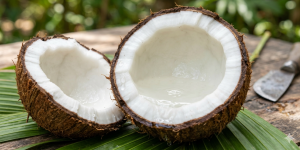
Coconut sugar takes a gentler path. Farmers climb the coconut palm (Cocos nucifera), score the unopened flower buds, and collect the nectar that drips out into bamboo containers. This sap is then slowly heated until the water evaporates and the sugars crystallize into warm, caramel-colored granules. There is no bleaching, no centrifuge, no chemical refining — which is why coconut sugar keeps the nutrients the palm originally packed into its sap.
Did You Know? The United Nations’ Food and Agriculture Organization (FAO) has described coconut palm sugar as one of the most sustainable sweeteners in the world — a single tree can produce sap for sugar for up to 20 years.
2. The Glycemic Index — Why Your Bloodstream Cares
The most cited reason people switch to coconut sugar is its lower glycemic index (GI). The GI is a 0–100 scale that measures how quickly a carbohydrate raises your blood glucose. The lower the number, the slower and steadier the rise.
Research published in Food Science & Nutrition places coconut sugar at a GI of around 35, while cane sugar typically falls between 58 and 65. To put that in context, anything under 55 is considered “low GI” — meaning coconut sugar slips into the same category as many fruits and whole grains, while refined cane sugar sits firmly in the “high” range.
Why does this matter? A slower glucose release means more sustained energy, fewer of those mid-afternoon crashes, and less of the insulin spike that, repeated over years, is linked to insulin resistance. Part of the credit goes to inulin, a soluble dietary fiber naturally present in coconut sapconut sap.
3. Flavor — The Underrated Advantage
Step into a kitchen using coconut sugar and the difference is immediate. Where cane sugar offers a single note — pure, sharp sweetness — coconut sugar brings caramel, toffee, and butterscotch undertones that come from the slow-evaporation process. Chefs and bakers have started calling it the “brown sugar with character.” It dissolves cleanly, browns beautifully, and gives desserts a warmth that white sugar simply can’t.
4. The Sustainability Story
Perhaps the most compelling case for coconut sugar isn’t on the nutrition label — it’s in the soil. Coconut palms thrive on marginal land — coastal soils, gentle slopes, places where sugarcane would struggle. They use a fraction of the water sugarcane demands, and a single tree keeps producing sap for around twenty years without replanting. Compare that to sugarcane, which is typically uprooted and replanted every one to two years, often after intensive irrigation and fertilization.
There’s a human story here too. In Indonesia, the Philippines, Sri Lanka, and other tropical economies, coconut sugar is overwhelmingly produced by smallholder farmers using traditional, low-tech methods passed down through generations. Buying coconut sugar directly supports rural livelihoods that industrial sugarcane plantations have, in many places, displaced.
5. Honest Limitations
A semi-scientific article should be honest about what coconut sugar isn’t:
•It is not calorie-free. Roughly the same energy density as cane sugar.
•It is not keto-friendly. It’s still primarily carbohydrate.
•Its mineral content, while higher, is still modest. Treat the nutrition as a small bonus.
•It costs more. The artisanal harvest and limited supply mean a higher price tag.
The honest takeaway: coconut sugar is a better-quality sugar, not a license to use more sugar. Used in moderation, it offers a genuinely lower-impact way to sweeten food — both for your body and for the planet.
Final Thoughts
The science is clear: coconut sugar is not a miracle food, but it is a meaningfully better alternative to refined cane sugar — gentler on your blood sugar, slightly richer in nutrients, more flavorful, and considerably kinder to the planet. For the growing community of consumers who care about what they put on the spoon — and where it came from — making the switch is one of the easiest, most enjoyable changes in the kitchen.
The next time you reach for a sweetener, ask yourself: do I want sweetness alone, or sweetness with a story?
Taste the Difference for Yourself
Our coconut sugar is harvested by smallholder farmers using traditional methods — slow-evaporated, naturally crystallized, and never refined. One spoonful is all it takes to understand why the world is making the switch.
Visit us at: https://eksplorrasa.com/
References
•Saraiva, A. et al. “Coconut Sugar: Chemical Analysis and Nutritional Profile.” NCBI.
•Trinidad, T. P. et al. “Glycemic index of carbohydrate foods.” Food Science & Nutrition.
•Cleveland Clinic Health Essentials. “Is Coconut Sugar Good for You?” (2023).
•Healthline. “Coconut Sugar — Nutrition Profile and Glycemic Impact.”
•FAO. Reports on sustainable sweetener production.
Disclaimer: This article is for informational and educational purposes. It is not medical advice. Always consult a qualified healthcare professional regarding dietary decisions.